Outdoor Cat Information
Limited Intake for Cats & Kittens
Multnomah County Animal Services (MCAS) limits intake of cats.
We accept cats that are:
- Sick or injured
- Abandoned, such as being left in a crate or in a vacated building without minimal care.
- In immediate danger due to cruelty, neglect, environmental hazards, and similar circumstances.
If you find an outdoor cat, check for a local owner.
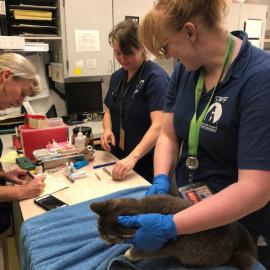
Call 503-988-7387 for guidance on what to do with cats that are unhealthy, injured, abandoned, or in other danger.

How to Help Outdoor Cats
What is an Outdoor Cat?
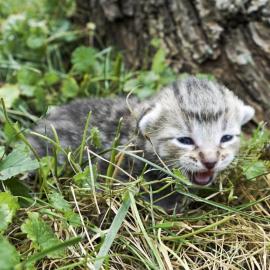
“Outdoor cat” is an umbrella definition that includes any outdoor cat, with or without an owner. It is difficult to determine a cat's ownership status, or how they live. Outdoor cats may be feral and unsocialized, or friendly. They may have been born wild. Some are lost or abandoned pet cats. Some outdoor cats have owners, and may live only outdoors, or may live indoors / outdoors. Some cats don’t have owners, but community members feed them. Others survive without human intervention.
Leave Healthy Cats Where They Are
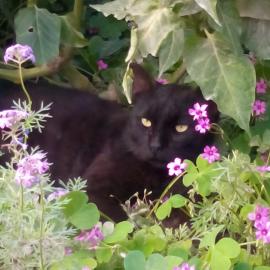
Leave cats where they are if they look healthy, well-fed, and uninjured. Or take them back to where you found them. Good body condition is a good indicator that the cat knows where home is, or where their caretaker feeds them.
Assuming outdoor cats are stray or feral may cause more harm than good. Removing them may separate them from their owners, caretakers, or their environment. Lost cats have a better chance of reuniting with their owners if we leave them where they are, and communicate with neighbors.
Cats are allowed to be “at large” according to the Multnomah County ordinance. However, if a cat is on your property, there are things you can do to discourage it.
Contact Us About Cats that are Sick, Injured, Abandoned, or In Danger
Call 503-988-7387 for guidance on what to do with cats that are unhealthy, injured, abandoned, or in other danger.
Learn what to do if you find kittens
Search for an Owner
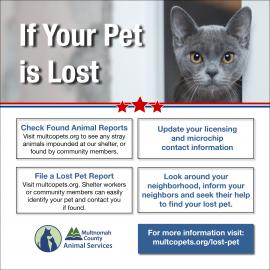
Many healthy cats — in the community — may actually have owners who allowed them to roam free. Community members who suspect that healthy outdoor cats in their neighborhood do not have a caretaker are encouraged to either verify a local owner, or attempt to find an owner if the cat is lost. Visit multcopets.org for information on ways to find owners of lost pets, including filing “found” reports, searching for owners in the neighborhood by distributing posters, while using other tools such as Nextdoor and social media to communicate.
Trap/Neuter/Return (TNR)
If there are many outdoor cats in your neighborhood, consider a trap/neuter/return (TNR) program. This humane program has proven results nationwide in alleviating many of the problems associated with outdoor cats.
- Feral Cat Coalition of Oregon (FCCO) is a TNR program that provides donation-based spay/neuter services for outdoor cats who are being fed by a caregiver. FCCO lends out traps, provides detailed instructions and how-to videos on the entire trapping, transport, and aftercare process, and can offer volunteer trapping assistance on a limited basis. Visit their website for a complete list of their services and how-to guides.
- www.feralcats.com
- Phone: (503) 797-2606
- Email: info@feralcats.com
- Mailing address: PO Box 82734, Portland, OR 97282
- Clinic address: 4522 SW Water Ave, Portland, OR 97239
- Portland Area Community Cat Caregivers
- Willamette Valley Trap/Neuter/Return Advocates
- Spay & Save: Low Cost Spay & Neuter Surgery for Owned Cats
(Photo of Ear-tipped cat. Caption: If you see a cat with a tipped ear, it is the official sign that they have already been spayed, neutered, and vaccinated.)
How to Tell if a Cat is Abandoned
- Was the cat found in an abandoned/empty home or building with no in/out access?
- Was the cat found in a kennel in a public area (sidewalk, outside a business, park, etc...) with no person present?
- Did you see someone physically abandon the cat in a public area (i.e., dump from a car or set carrier down and walk away)?
- Does the cat have an ear-tip (the upper part of the right or left ear has been clipped off straight across)? If so, this cat was fixed and re-released to the neighborhood. It is already home.
- If you think a cat is lost/abandoned, is this the first time you've seen this cat in the area? If not, have you noticed a decline in its physical appearance?
- Is the cat generally healthy-looking (groomed coat, good weight, no obvious injuries or illness)? This generally means the cat has a food source and is comfortable in their environment.
- Or does the cat appear unthrifty (dirty, ungroomed coat, thin/emaciated, obviously sick/injured)? This generally means the cat does not have an active caretaker and/or food source, or may not be familiar with the area to know where resources are.
- Have you asked neighbors if they own - or know who owns - the cat? Posted fliers, posted on social media apps such as Facebook or Next Door?
Resources for Outdoor Cats
- Keeping Cats Out of Your Garden
- ASPCA Community Cat Resources
- HSUS Tips for Keeping Outdoor Cats Safe
- Alley Cat Allies: Ideas for Temporary and Permanent Cat Shelters
- Neighborhood Cats: Building Winter Shelter
For questions about helping outdoor cats, please contact 503-988-7387 or mail.pet@multco.us.
About Our Cat Intake Policy
Following recommendations from the National Animal Care & Control Association (NACA), Multnomah County Animal Services (MCAS) only accepts outdoor adult cats* that are:
- Sick
- Injured
- Abandoned, such as being left in a crate or in a vacated building.
- In immediate danger due to cruelty, neglect, and similar circumstances.
- Kittens between the ages of six (6) and twelve (12) weeks old
Learn what to do if you find kittens, and how to know how old they are.
Why doesn’t MCAS take healthy outdoor cats?
New findings from NACA show that impounding healthy adult cats is not the best way to help the cats, their owners, or the neighborhoods where they live.
Impoundment of healthy adult cats:
Reduces the likelihood of reuniting families with pets
Lost cats are 10-50 times more likely to be reunited with their owners if they stay where they were found instead of being brought to an animal shelter. They are more likely to return on their own or be found by their families.
Affects low-income and marginalized community members the most
Low-income pet owners face barriers to visit animal shelters due to transportation, limited time during business hours, or other costs, and are less likely to call or visit animal shelters to reclaim lost pets.
Reduces the capacity of Animal Services to respond to critical community needs
Shelters with a high cat population can quickly become overwhelmed and overcrowded, and have less capacity to provide critical care and outcomes for abused, neglected, injured, or sick animals, and support for the pets of families in crisis.
Can increase cat populations and their negative impact
Because removing cats may lead to different cats moving in (especially if there is a food source), it is not an effective way to manage the outdoor cat population.
Doesn’t solve nuisance behaviors
Removing cats because of nuisance behaviors is less likely to solve core problems like cats feeding from open garbage containers that may be attracting cats, rodents, and other animals.
TNR programs that leave cats where they are and manage their environment are better able to solve nuisance issues with cats